

Blog: finance and real estate made simple
Articles and insights to help you navigate and grow
The Challenges of Buying a Third Property: How Financing Rules Are Changing?

Purchasing a third property can be an attractive way to grow your assets or expand your investment portfolio. However, as of 1 April 2026, financing such a purchase comes with stricter conditions.
The reason is a change in the recommendations issued by the Czech National Bank (CNB) regarding investment mortgages. Under the new rules, this category includes not only properties purchased for investment purposes but automatically any third or subsequent residential property. Therefore, if you already own two residential properties, financing another one falls under a stricter lending regime.
This change does not affect only major investors; it may also impact ordinary families. For example, if you own an apartment and a holiday cottage, any additional property you wish to purchase—whether an apartment for your child, a small house for a grandparent, or a second holiday home—will now be subject to stricter financing conditions.
When purchasing a third or subsequent residential property, the intended purpose of the purchase is irrelevant. The same rules apply whether you are buying the property for your own use, to rent it out, or for any other purpose.
From April 2026, banks apply the following limits to these loans:
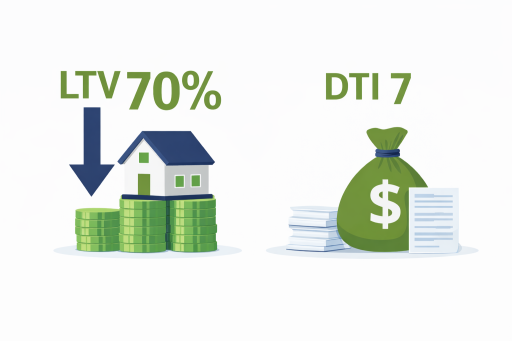
- Maximum LTV of 70% (loan-to-value ratio, meaning the loan amount relative to the property's value).
- Maximum DTI of 7 (debt-to-income ratio, meaning total debt expressed as a multiple of annual net income).
When buying a third property, you therefore need more of your own funds and sufficient income in relation to your total outstanding debt.
Practical Example
A family that already owns an apartment and a holiday cottage wants to purchase another apartment for CZK 6 million.
1. With an LTV limit of 70%, the maximum mortgage amount is CZK 4.2 million. The remaining CZK 1.8 million must be covered from the family's own funds. Alternatively, another property may be used as additional collateral.
2. The DTI limit also comes into play. If the household has an annual net income of CZK 1 million, its total outstanding debt may not exceed CZK 7 million under a DTI limit of 7.
How Are Ownership Shares Calculated?
An important factor is the size of your ownership share in existing properties:
- An ownership share of less than 50% is not included in the property count.
- An ownership share of 50% or more counts as one whole property.
- Ownership shares in different properties are not added together.
- This is particularly important for married couples.
If you own an apartment and a holiday cottage under the Czech marital community property regime (společné jmění manželů, or SJM), both properties count in full for each spouse under these rules.
If you apply jointly for a mortgage to purchase another property, both spouses are therefore considered to already own two properties, making the new purchase their third property under the CNB's rules.
Let us return to our example of a family owning an apartment and a holiday cottage. If both properties are held as marital community property, each spouse is considered to own both properties for the purposes of these rules. When applying jointly for a mortgage, both spouses therefore already have two qualifying properties, and the new property is treated as their third.
However, the situation may be different if the spouses formally divide their assets through a notary—for example, so that the husband becomes the sole owner of the holiday cottage and the wife becomes the sole owner of the apartment.
If only one spouse subsequently applies for a new mortgage individually, and the newly purchased property is also acquired in that spouse's sole ownership (outside the marital community property regime), the bank will record only one existing property for that applicant.
The newly purchased apartment would therefore be considered their second property, potentially allowing access to standard, more favourable mortgage conditions.
However, it is important to remember that the bank will assess mortgage affordability based solely on the income of the spouse applying for the loan.
Construction and Renovation
The stricter rules do not apply to loans intended exclusively for construction or renovation.
However, purchasing an older apartment with the intention of renovating it afterwards is treated differently. In this case, the transaction is considered a standard purchase of a third property, and the stricter limits apply.
What If You Plan to Sell an Existing Property?
If you intend to sell one of your existing properties, this may affect how your mortgage application is assessed.
However, simply stating that you plan to sell the property is not sufficient. Your intention must be supported by verifiable documentation, and the bank must assess the specific circumstances.
This can be particularly important when moving home and purchasing a new property before selling your current residence.
Final Thoughts
If you already own two properties and are considering purchasing a third, it is essential to plan your financing well in advance—ideally before signing a reservation agreement.
Buying a third property does not automatically mean that obtaining a mortgage will be a problem. However, you should be prepared for stricter financing conditions.
The key factors are the number of properties counted under the rules, the ownership structure, the amount of your own funds available, and your overall financial situation.

Kalkulačka
Calculate
-
Monthly installment
Next step with Stone & belter
Stone & belter blog
Similar articles
Category

12.10.2026
The Challenges of Buying a Third Property: How Financing Rules Are Changing?
Mgr. Petra Šichová
10.06.2026
Mortgage Fixed Rate Expiring? Don’t Accept the First Offer from Your Bank Without Checking Your Options.
Ondřej Marek
21.04.2026
30 Years of Mortgages in the Czech Republic: Hindsight Is 20/20 — But What Can We Learn?
12.03.2026
Investment Mortgages to Face Stricter Rules: What Will the New Regulation Bring in 2026?
Ing. Lukáš Cinko



11.06.2025
Understanding the Mortgage Process for Foreigners in the Czech Republic – Part 2
Mgr. Petra Šichová

10.02.2025
Czech National Bank Cuts Interest Rates to 3.75%: What This Means for Your Savings, Mortgages, and Investments
Ondřej Marek

29.09.2024
Mortgages and Interest Rates: Why Are They More Expensive Than Everyone Expected?
Ondřej Marek
28.05.2024
Early Mortgage Repayment Will Get More Expensive – Limiting “Mortgage Tourism”
Ing. Lukáš Cinko
16.04.2024
Options for Reducing Your Mortgage Interest Rate During the Fixed Period
Ing. Alena Lodlová12.10.2026
The Challenges of Buying a Third Property: How Financing Rules Are Changing?
Mgr. Petra Šichová10.06.2026
Mortgage Fixed Rate Expiring? Don’t Accept the First Offer from Your Bank Without Checking Your Options.
Ondřej Marek21.04.2026
30 Years of Mortgages in the Czech Republic: Hindsight Is 20/20 — But What Can We Learn?
12.03.2026
Investment Mortgages to Face Stricter Rules: What Will the New Regulation Bring in 2026?
Ing. Lukáš Cinko11.06.2025
Understanding the Mortgage Process for Foreigners in the Czech Republic – Part 2
Mgr. Petra Šichová10.02.2025
Czech National Bank Cuts Interest Rates to 3.75%: What This Means for Your Savings, Mortgages, and Investments
Ondřej Marek29.09.2024
Mortgages and Interest Rates: Why Are They More Expensive Than Everyone Expected?
Ondřej Marek28.05.2024
Early Mortgage Repayment Will Get More Expensive – Limiting “Mortgage Tourism”
Ing. Lukáš Cinko16.04.2024
Options for Reducing Your Mortgage Interest Rate During the Fixed Period
Ing. Alena Lodlová10.02.2025
Czech National Bank Cuts Interest Rates to 3.75%: What This Means for Your Savings, Mortgages, and Investments
Ondřej Marek