

Blog: finance and real estate made simple
Articles and insights to help you navigate and grow
The Most Common Causes of Disability Pensions: What Truly Poses the Greatest Risk to Us?

From time to time, we may come across insurance offers where insurers — most often as part of a promotional campaign — provide coverage for the risk of receiving a state-recognized disability pension due to an accident free of charge. But how beneficial are these offers really, and is it worth accepting them?
People often automatically associate disability with severe accidents such as limb amputations, brain injuries, or spinal cord injuries resulting in paralysis. However, statistics show that disability caused by accidents accounts for only around 4% of all granted disability pensions. Approximately 96% of disability cases are caused by illnesses — for example, oncological, neurological, psychological, or cardiovascular diseases.
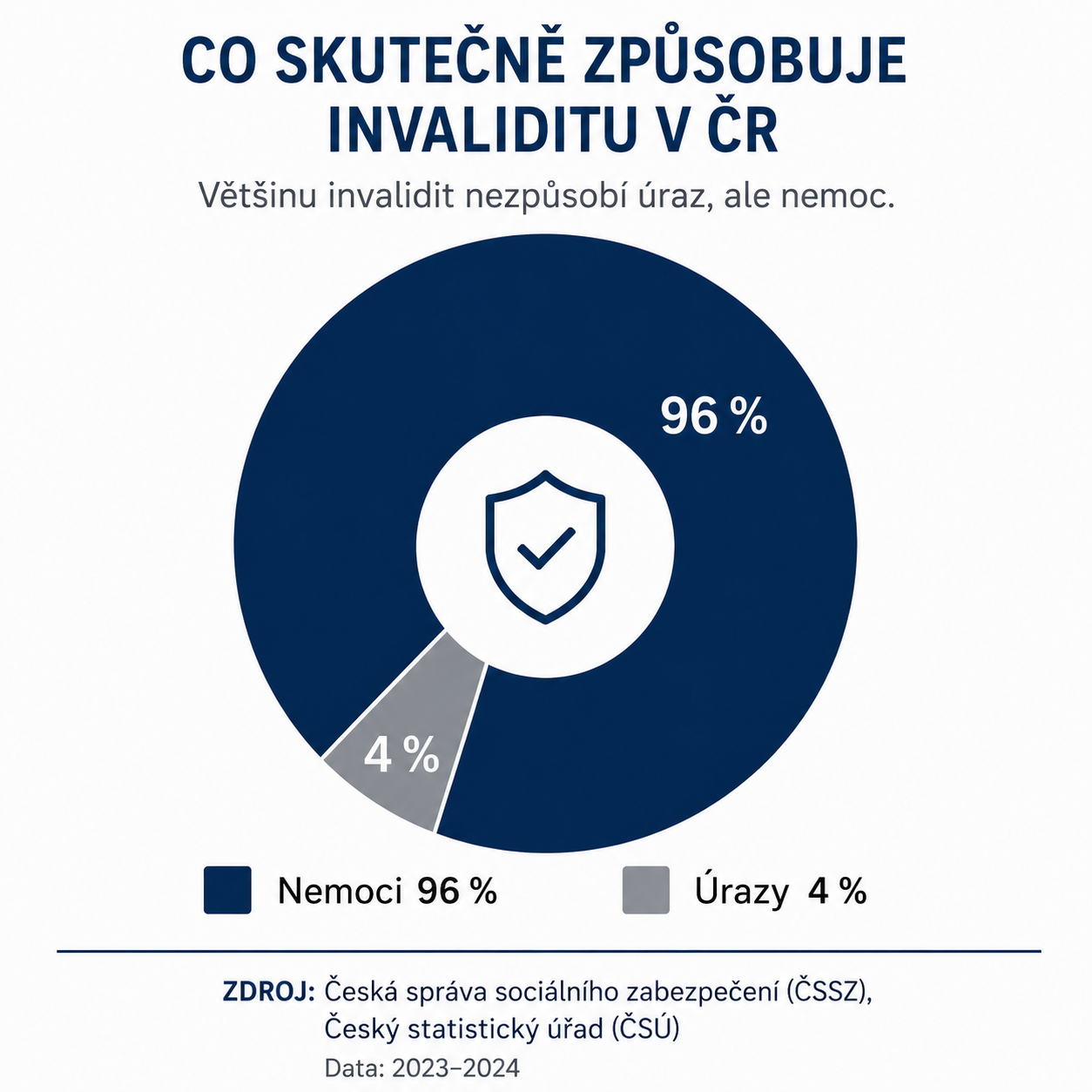
This means that insurance focused solely on disability caused by accidents covers only a very small portion of the actual risk. If such an offer is truly free of charge — without hidden conditions, increased prices of other products, or the obligation to purchase additional services — it may make sense to accept it. After all, it provides some extra protection at no cost.
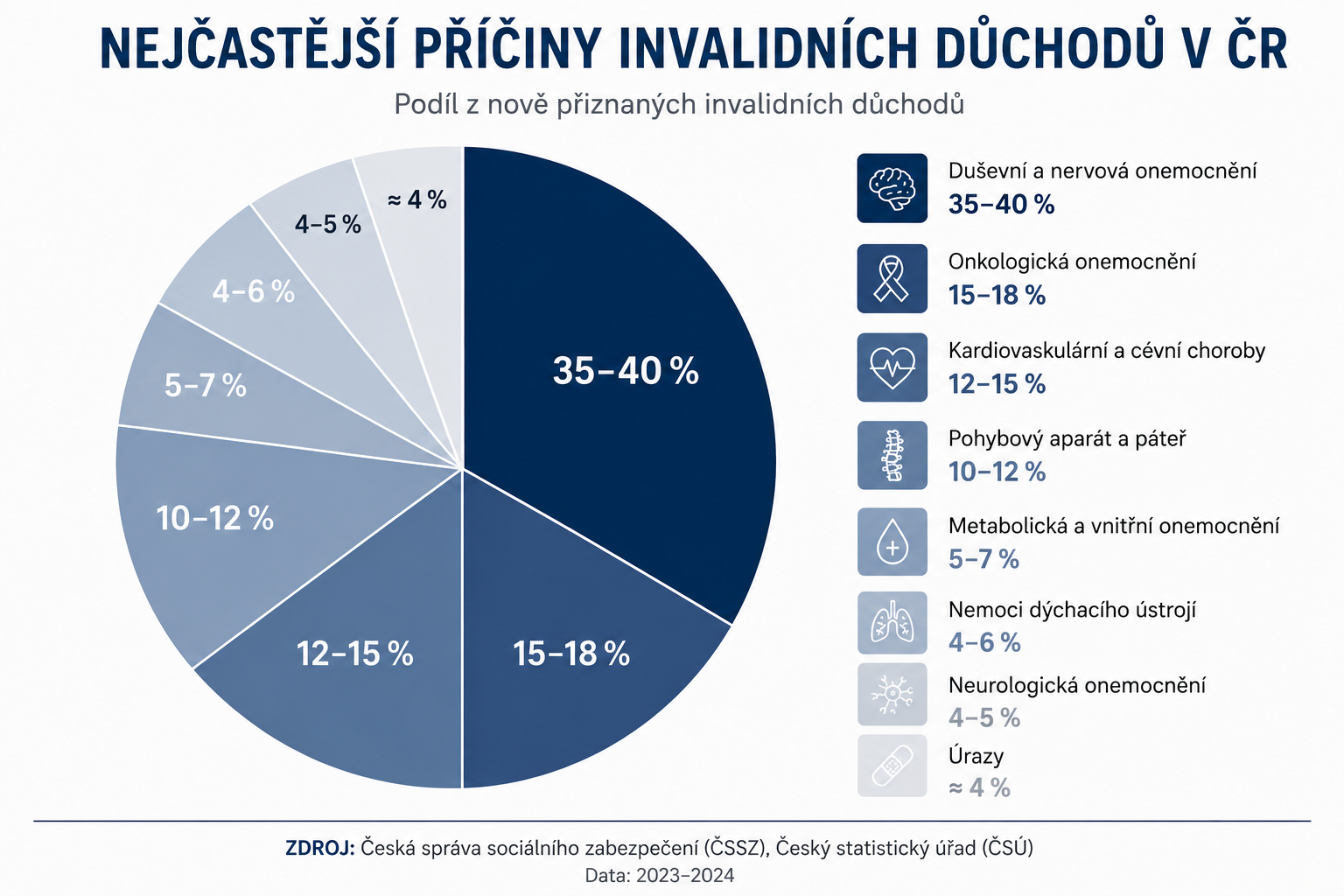
However, according to current data from the Czech Social Security Administration (ČSSZ) — as well as real-life experience from medical assessment commissions — the most common causes of disability pensions are the following:
Nervous System and Mental Disorders (the most common cause) account for approximately 35–40% of all newly granted disability pensions.
- Depression, anxiety disorders, bipolar disorder
- Schizophrenia and schizoaffective disorders
- Organic mental disorders (e.g., after brain injuries)
- Dementia, Alzheimer’s disease, Parkinson’s disease
Oncological Diseases account for approximately 15–18% of all cases.
- Breast, lung, prostate, and colorectal cancers, leukemia, lymphomas
- Chemotherapy and radiotherapy are often followed by a permanent reduction in performance capacity
Cardiovascular and Vascular Diseases represent approximately 12–15%.
- Myocardial infarction, ischemic heart disease, heart failure
- Strokes and transient ischemic attacks (TIA)
- Severe hypertension with complications
Musculoskeletal and Spinal Disorders account for approximately 10–12%.
- Degenerative spinal conditions (herniated discs, spinal canal stenosis)
- Osteoarthritis, rheumatoid arthritis, ankylosing spondylitis
- Chronic back pain, reduced mobility, post-traumatic conditions
Respiratory Diseases make up approximately 4–6%.
- Chronic obstructive pulmonary disease (COPD)
- Severe asthma
- Pulmonary fibrosis
Metabolic and Internal Diseases account for approximately 5–7%.
- Diabetes mellitus with complications (amputations, kidney failure, neuropathy, retinopathy)
- Chronic liver and kidney diseases
Neurological Diseases represent approximately 4–5%.
- Multiple sclerosis (MS)
- Epilepsy
- ALS, neuropathies, myopathies
Not exactly cheerful reading, is it?
Even the best insurance cannot prevent illness or accidents. What it can do, however, is help you overcome difficult moments after becoming disabled and adapt your life to a new reality — despite all the “guaranteed advice” you may come across in various internet discussions.
If you want to act responsibly toward yourself or your family and would like to discuss your options, feel free to contact us.

Stone & belter blog
Similar articles
Category

21.07.2026
Summer is full of great experiences. Just don't let any of them become unnecessarily expensive.
Ing. Tomáš Matucha
15.06.2026
A CZK 300 Saving on Insurance Turned Into a CZK 25,000 Problem in Croatia.
Martin Jirásek
19.05.2026
The Most Common Causes of Disability Pensions: What Truly Poses the Greatest Risk to Us?
Vladimír Bádr

12.02.2026
One spark. CZK 550,000 in damage. And a battle over whether the insurance would pay.
Petr Dobrovolný

14.11.2025
You pay for insurance - but does it really cover what you need? How to recognize quality coverage and not waste money.
Ing. Lukáš Cinko


11.08.2025
13 Million That Costs Only a Few Hundred in Your Twenties – Why Life Insurance Makes Sense
Petr Dobrovolný
11.06.2025
Travel Insurance: How Not to Pay More Than You Have To – and Still Be Truly Protected
Martin Jirásek


09.04.2025
How to Set Up Vehicle Assistance Services and Avoid Ruining a Family Trip (Not Just) in a Camper Van
Martin Zelenka
21.07.2026
Summer is full of great experiences. Just don't let any of them become unnecessarily expensive.
Ing. Tomáš Matucha15.06.2026
A CZK 300 Saving on Insurance Turned Into a CZK 25,000 Problem in Croatia.
Martin Jirásek19.05.2026
The Most Common Causes of Disability Pensions: What Truly Poses the Greatest Risk to Us?
Vladimír Bádr12.02.2026
One spark. CZK 550,000 in damage. And a battle over whether the insurance would pay.
Petr Dobrovolný14.11.2025
You pay for insurance - but does it really cover what you need? How to recognize quality coverage and not waste money.
Ing. Lukáš Cinko11.08.2025
13 Million That Costs Only a Few Hundred in Your Twenties – Why Life Insurance Makes Sense
Petr Dobrovolný11.06.2025
Travel Insurance: How Not to Pay More Than You Have To – and Still Be Truly Protected
Martin Jirásek09.04.2025
How to Set Up Vehicle Assistance Services and Avoid Ruining a Family Trip (Not Just) in a Camper Van
Martin Zelenka