
How much does a dignified funeral really cost?

“From dust you are, and to dust you shall return.”
From the day of our birth, we are only visitors in this world, and sooner or later we all set out for the other shore. But how much does such a “ticket” actually cost?
Although there is no legal obligation in the Czech Republic to bury one’s relatives, most of us will face this sad duty at some point in our lives. We can marry several times in a lifetime, but we die only once. That is also why general awareness of the current costs of a funeral is relatively low.
First of all, we must realize that funeral services are a highly competitive industry and a business like any other—only with business plans operating in an emotionally fragile environment.
To keep costs within reasonable limits, it is therefore advisable for the final farewell to be arranged by someone close who knew the deceased, but is not as emotionally affected as the closest relatives and can thus more easily resist certain practices that can dramatically increase the price of a funeral.
As an example, one can choose a ceremonial coffin made of oak instead of poplar—even for cremation. Savings can also be made by ordering a bouquet tied with a ribbon into a circle instead of a wreath. In the words of the classics: the visual difference is minimal, the price difference substantial.
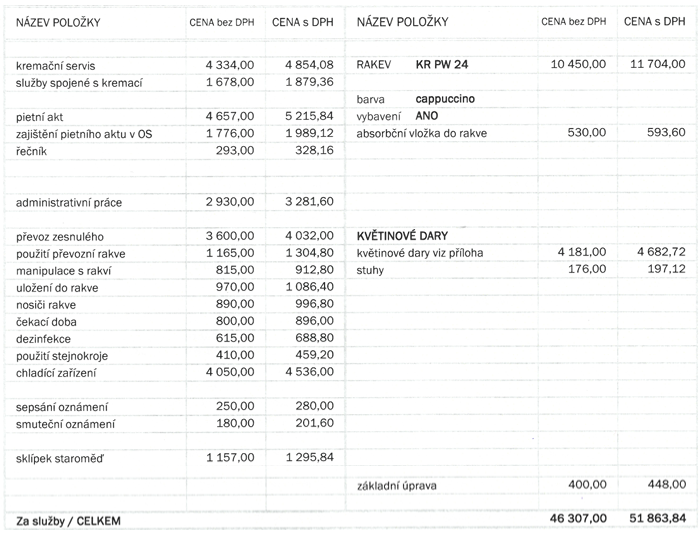
Even with these “cost brakes,” however, one must still expect that a modest yet dignified final farewell will cost over CZK 50,000. You can see the amounts of the individual items on an invoice that is less than three months old.
Abuse of social funerals
Although a dignified farewell to the deceased should be a matter of honor, there are still various “smart operators” who abuse so-called social funerals—and even boast about how well they know how to work the system.
If no one claims the deceased within 96 hours of the death being reported, or if their identity is not established within a week, the municipality where the person died is obliged to arrange the funeral.
The law stipulates that in such cases the urn is issued only to the municipality and must be placed without delay in a cemetery. The bereaved therefore have no legal right to receive the urn. Sometimes, however, municipalities—often in an effort to accommodate families—hand the urn over to relatives if they subsequently cover part of the costs. While this may be humanly understandable, it constitutes a breach of legal obligations.
In rare cases, this can even create room for systematic abuse. According to experts, people may try to save money in this way, as the average cost of a social funeral can be up to three times lower than that of a funeral with a ceremony.
The purpose of this article, however, is not to provide a guide on how to find the “cheapest funeral,” but rather how to have peace of mind knowing that one’s family will not have to deal with the additional stress of a lack of money at a time of grief. These final matters are not easy to talk about—but that is precisely why it is worth opening them up before circumstances force us to. Not so that we are afraid, but so that we ease the burden on those we love. A sufficient financial reserve and a few sentences spoken at the kitchen table can one day mean enormous relief during a difficult period.
If you wish, I am available for a consultation: to discuss what level of reserve makes sense to build, how to set it up, and how to talk about it within the family in a sensitive and practical way.

Stone & belter blog
Similar articles
Category



12.10.2026
The Challenges of Buying a Third Property: How Financing Rules Are Changing?
Mgr. Petra Šichová
05.10.2026
From Banker to Advisor: What It’s Like to Start from Scratch After 20 Years
Ing. Lucie Kreperátová


10.09.2026
A Well-Planned Business Owner’s Reserve: Idle Cash or Peace of Mind?
Ing. Marek Jůzl, EFP
19.08.2026
From Elite Sports to Financial Freedom: Why Is It Crucial to Listen to What the Client Isn’t Saying?
Petr Seibot
18.08.2026
Young People and Homeownership: An Unattainable Dream or a Matter of Planning?
Ondřej Marek



05.08.2026
How Investment Selection Reveals Whether a Financial Advisory Firm Is Truly Independent
Ondřej Marek
21.07.2026
Summer is full of great experiences. Just don't let any of them become unnecessarily expensive.
Ing. Tomáš Matucha
12.10.2026
The Challenges of Buying a Third Property: How Financing Rules Are Changing?
Mgr. Petra Šichová
05.10.2026
From Banker to Advisor: What It’s Like to Start from Scratch After 20 Years
Ing. Lucie Kreperátová19.08.2026
From Elite Sports to Financial Freedom: Why Is It Crucial to Listen to What the Client Isn’t Saying?
Petr Seibot05.08.2026
How Investment Selection Reveals Whether a Financial Advisory Firm Is Truly Independent
Ondřej Marek21.07.2026